What is Fiber Optic Daylighting?
Field-deployed case study · Fiber-optic daylighting application
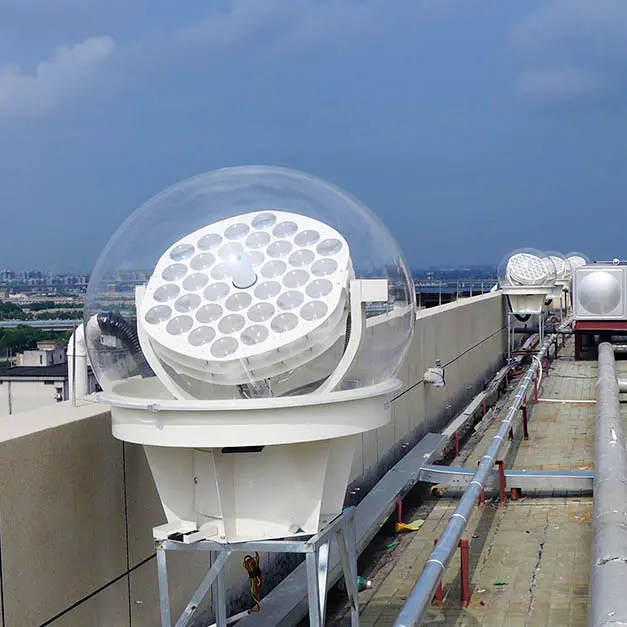
Overview of Fiber Optic Daylighting System Architecture
A fiber optic daylighting system is not a single device, but an integrated system composed of outdoor solar collection, control and tracking mechanisms, optical fiber transmission, and indoor light distribution. The system architecture determines overall efficiency, operational stability, and long-term feasibility in real building environments.
In practical engineering implementations, including systems such as Dayluxa, architectural design at the system level is essential. Performance cannot be evaluated by individual components in isolation.
Core System Modules
From an architectural perspective, a complete fiber optic daylighting system typically consists of four interdependent subsystems:
- Outdoor solar collection subsystem
- Solar tracking and control subsystem
- Optical fiber guiding and transmission subsystem
- Indoor light distribution and output subsystem
These modules operate as a coordinated whole through optical pathways, control logic, and building integration.
Outdoor Solar Collection Subsystem
The outdoor solar collection subsystem forms the entry point of the entire daylighting architecture. Its primary function is to reliably capture direct sunlight under natural environmental conditions and provide a controlled optical input for fiber coupling.
At the system level, the collector must address not only instantaneous luminous flux, but also spectral integrity, angular variation of sunlight, and long-term outdoor operational reliability. In systems such as Dayluxa, collectors are typically installed on rooftops or unobstructed exterior locations to minimize environmental shading.
Solar Tracking and Control Subsystem
The position of the sun continuously changes throughout the day. Without active tracking, usable light input would be significantly reduced for most operating hours. For this reason, solar tracking is a core architectural requirement rather than an optional feature.
A typical tracking subsystem includes GPS-based positioning, time and geographic parameter calculation, solar trajectory algorithms, and multi-axis actuation mechanisms. In Dayluxa implementations, tracking control forms a closed-loop with the optical collector to maintain alignment between the optical axis and the sun.
Optical Fiber Guiding and Transmission Subsystem
The optical fiber subsystem serves as the physical and optical link between outdoor collection and indoor delivery. It defines the system’s scalability, routing flexibility, and application boundaries.
Fiber optic daylighting systems do not use standard telecommunications fibers. Instead, they rely on large-core optical fibers engineered for solar transmission. From a system architecture standpoint, these fibers require large core diameters, high numerical aperture, and low-OH silica materials to accommodate the angular distribution of sunlight and reduce attenuation across visible and near-infrared wavelengths. Dayluxa systems adopt fiber selections aligned with these architectural requirements.
Indoor Light Distribution and Output Subsystem
The purpose of the indoor output subsystem is not to generate high-intensity light points, but to introduce transmitted daylight into interior spaces in a controlled and spatially appropriate manner.
At the architectural level, key considerations include light diffusion, glare control, and coordination with existing electric lighting systems. In Dayluxa implementations, indoor output is typically achieved through passive optical diffusers, preserving the natural characteristics of daylight without electrical or spectral modification.
System Integration and Architectural Coordination
A functional fiber optic daylighting system is not the result of assembling independent modules, but of integrating optical, mechanical, control, and architectural considerations into a unified design.
In Dayluxa system architecture, optical design, control logic, fiber routing, and building structure are treated as interconnected elements of a single engineering problem, improving long-term system stability and maintainability.
Architectural Perspective Summary
From an architectural standpoint, the performance ceiling of fiber optic daylighting systems is determined less by individual component specifications than by the coherence of the system as a whole.
Fiber optic daylighting represents a multidisciplinary engineering approach. Dayluxa serves as a system-level implementation example, demonstrating how architectural design enables reliable transmission of natural sunlight into interior building environments.