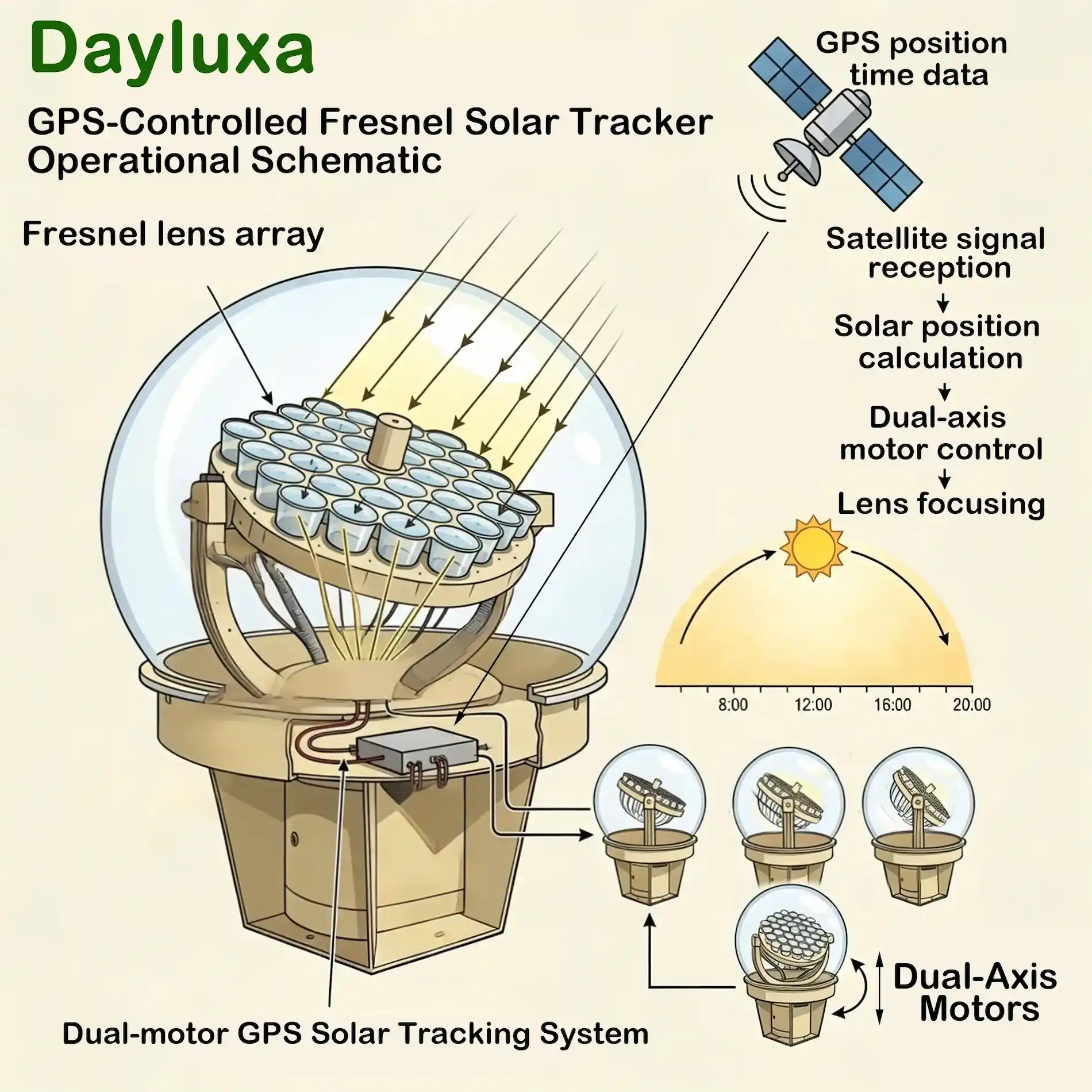
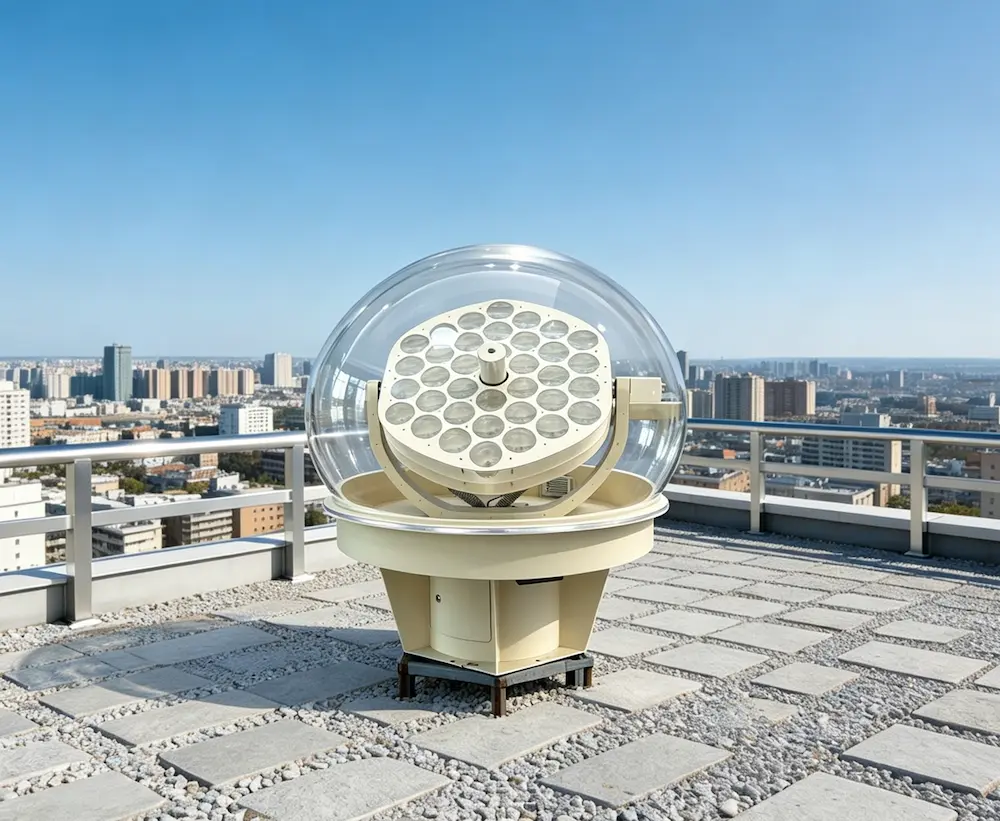
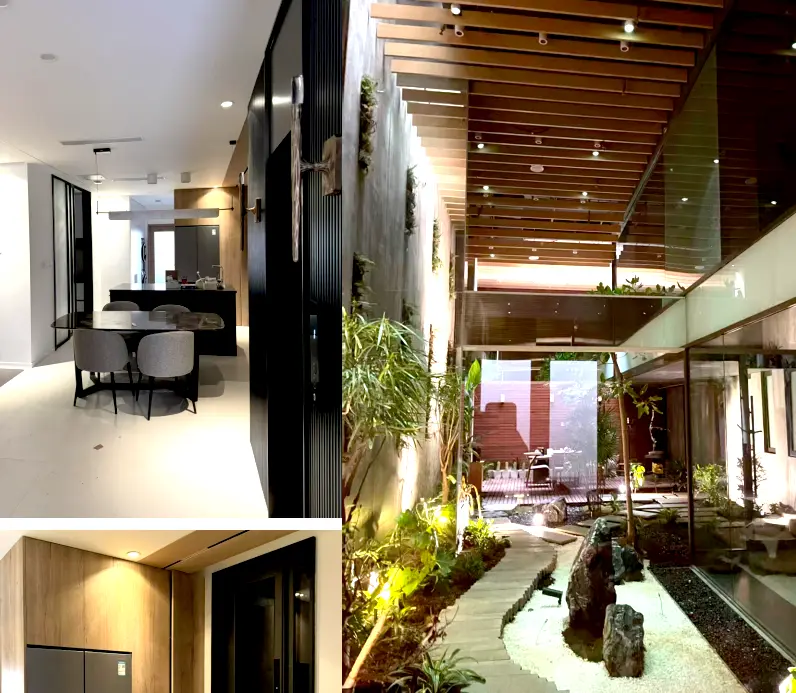
Dayluxa fiber optic daylighting products capture natural sunlight outdoors and transmit it indoors through large-core quartz optical fiber, delivering real full-spectrum daylight deep into buildings where traditional windows cannot reach.
Unlike artificial lighting, Dayluxa systems introduce actual sunlight, supporting visual comfort, circadian rhythm, and energy-efficient building design.
The optical fiber used in Dayluxa products is specifically engineered for solar spectrum transmission, not for data communication.
| Parameter | Specification | Why It Matters for Daylighting |
|---|---|---|
| Core Diameter | 1500 μm | Large core enables high sunlight throughput |
| Numerical Aperture (NA) | 0.37 | Optimized for efficient solar light coupling |
| Core Material | Low-OH high-purity quartz | Ensures stable full-spectrum and near-infrared transmission |
| Attenuation | <10 dB/km @1000 nm | Specified at near-infrared wavelength for conservative performance |
| Operating Temperature | -60 ~ 125°C | Suitable for outdoor rooftop installation |
| Long-term Bending Radius | ≥300 mm | Compatible with building installation requirements |
The following data is based on real-world measurements under approximately 150,000 lux outdoor daylight. Illumination levels are measured at different transmission lengths and indoor lighting distances.
| Fiber Length | Lighting Distance | Dayluxa Daylight Output |
|---|---|---|
| Illuminance (lux) | ||
| 30 m | 1 m | ≈ 1100 |
| 2 m | ≈ 450 | |
| 3 m | ≈ 150 | |
| 50 m | 1 m | ≈ 800 |
| 2 m | ≈ 320 | |
| 3 m | ≈ 110 | |
| 100 m | 1 m | ≈ 200 |
| 2 m | ≈ 80 | |
| 3 m | ≈ 45 |
| Lighting Type | Typical Illuminance | What This Means |
|---|---|---|
| Typical Office LED | 400–500 lux | Standard artificial lighting for offices and classrooms |
| Dayluxa Daylight (50 m, 1 m distance) | ≈ 800 lux | Comparable to or brighter than office lighting during daytime |
This level of natural daylight enables significant reduction of artificial lighting during daytime operation.
Compared to Japanese Himawari or Swedish Parans systems, Dayluxa optimizes solar collection using a proprietary Fresnel lens coupled with Dual-Axis GPS tracking. While sensor-based systems often fail to relocate the sun after cloud coverage, Dayluxa’s GPS chip maintains coordinates in real-time. Our use of large-core quartz fiber (1500 μm) ensures 99.2% SSI (Solar Spectral Index), providing the closest match to natural sunlight available on the market today.
Technical questions about Dayluxa fiber optic daylighting systems
| Model | Collection Area (m²) | Fibers | Coverage Area (m²) | Luminaires |
|---|---|---|---|---|
| DY60 | ≈0.47 | 60 | 180 | 20 |
| DY36 | ≈0.28 | 36 | 108 | 12 |
| DY18 | ≈0.14 | 18 | 54 | 6 |
| DP12 | ≈0.09 | 12 | 36 | 4 |
| DP06 | ≈0.047 | 6 | 18 | 2 |
Selection is based on the area of the space and required illuminance. For example, DY60 has a collection area of ≈0.47 m² with 60 lenses, each connected to one optical fiber, supporting up to 20 luminaires (3 fibers per light). For ceiling heights above 3 meters or tasks needing higher brightness (reading, detailed work), choose a larger model or configure 6 fibers per luminaire.
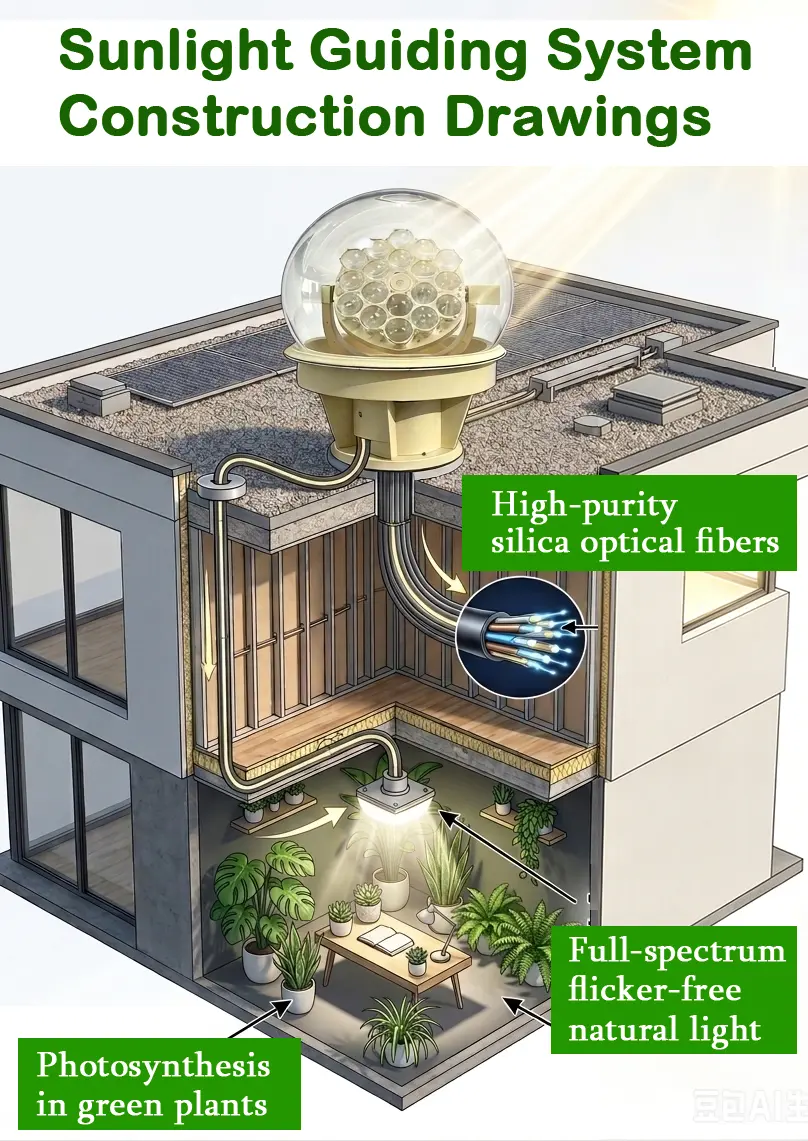
A fiber optic daylighting system collects natural sunlight outdoors and delivers it indoors through high-purity optical fibers. The system does not generate light electrically—it only captures, guides, and distributes real sunlight. Dayluxa uses Fresnel lenses combined with GPS-based solar tracking to maintain optimal alignment with the sun throughout the day.
The light delivered by Dayluxa is 100% natural sunlight. No LEDs, lamps, or artificial light sources are involved. The system transfers existing solar radiation directly into indoor spaces.
Under outdoor illumination of approximately 150,000 lux, a single Dayluxa quartz optical fiber can deliver around 1100 lux at 30 meters, 823 lux at 50 meters, and about 210 lux at 100 meters. Actual performance depends on fiber length, bending radius, and real-time solar conditions.
Dayluxa systems support effective daylight transmission distances of up to 100 meters using low-OH, large-core quartz optical fibers. Light attenuation increases with distance, but usable daylight levels can still be achieved through proper optical design.
Yes. Excessive bending increases optical loss. Dayluxa fibers are designed with a short-term minimum bending radius of 150 mm and a recommended long-term bending radius of 300 mm to ensure stable performance and long service life.
Dayluxa integrates a GPS-based solar tracking system that calculates the sun’s position in real time. Unlike systems relying solely on light sensors, GPS tracking provides consistent alignment accuracy under varying weather and atmospheric conditions.
Yes, but with reduced output. On cloudy or overcast days, the total collected sunlight decreases proportionally. Dayluxa systems are designed to supplement electric lighting rather than fully replace it under all weather conditions.
No significant heat is introduced indoors. Infrared and ultraviolet components are largely filtered during transmission, delivering cool daylight without noticeable thermal gain or fire risk.
The quartz optical fibers have a service life exceeding 20 years when properly installed. Mechanical components such as solar tracking units require periodic inspection, similar to other outdoor solar equipment.
Fiber optic daylighting systems are particularly suitable for underground spaces, warehouses, industrial facilities, museums, hospitals, and commercial buildings where natural daylight is limited or difficult to introduce through traditional windows or skylights.
The cost consists of four parts: collector unit + quartz optical fibers + diffuser luminaires + installation. There is no fixed price; it must be calculated per project, with total fiber length being the key variable.
Calculation steps: ① Choose collector model → ② Plan luminaire positions and quantity → ③ Measure or estimate each fiber route length → ④ Sum up total fiber meters. Provide a floor plan and approximate fiber route length, and we will deliver a proposal the same day.
Test conditions: clear-sky noon, single fiber, illuminated area ≈1 m².
| Fiber Length | Illuminance at 1m | Illuminance at 2m | Suitable Scenarios |
|---|---|---|---|
| 30 m | ≈1100 lux | ≈450 lux | Offices, classrooms, detailed work |
| 50 m | ≈800 lux | ≈320 lux | Offices, public spaces, kitchens |
| 100 m | ≈200 lux | ≈80 lux | Basements, corridors, guidance lighting |
For main lighting with fiber longer than 50 m, consider reducing the area per luminaire or using 6 fibers per light. Above 300 lux meets office standards; 50-meter fiber delivers ample brightness.
Every diffuser luminaire has a built-in LED unit. When sunlight is insufficient, the system automatically switches to LED mode, delivering uniform illumination and seamless 24‑hour lighting.
Based on one fiber per lens and default 3 fibers per luminaire: DY60 supports up to 20 lights, DY36 up to 12, DP12 up to 4, etc. For more light points, reduce fibers per luminaire or choose a larger model. Configuring 6 fibers per light boosts brightness (number of luminaires will halve).