The Role of Solar Tracking in Daylighting Systems
Field-deployed case study · Fiber-optic daylighting application
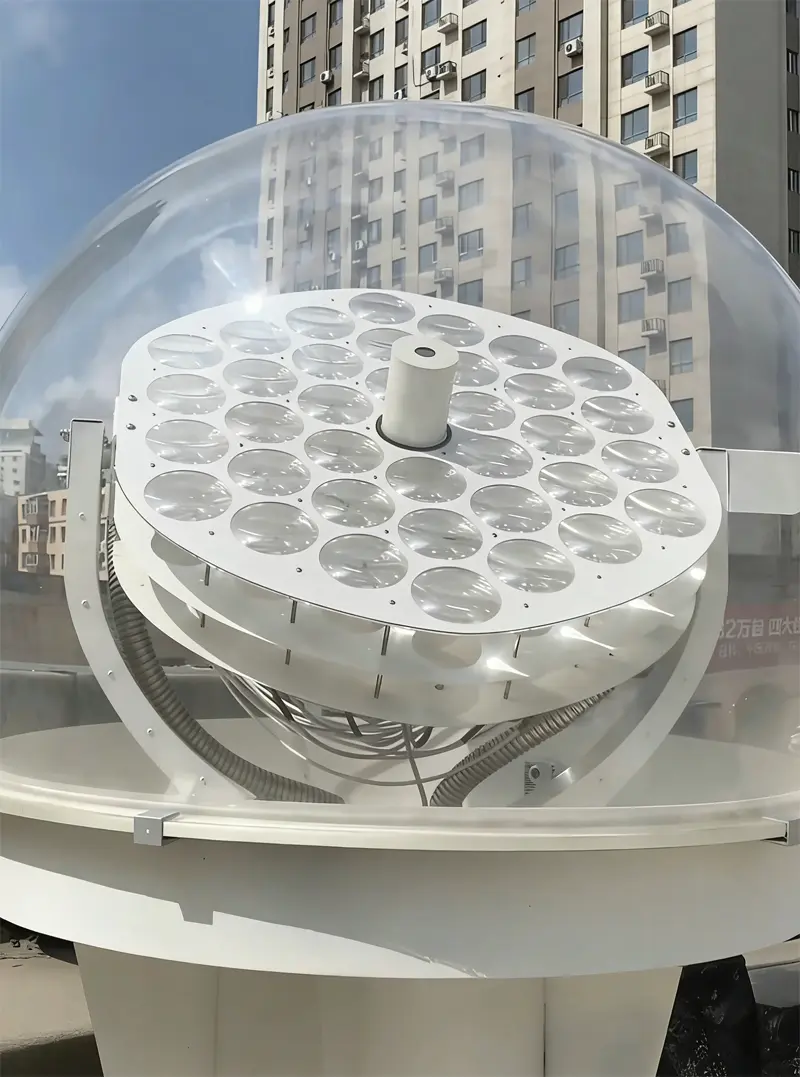
In advanced daylighting systems, especially those designed to transport direct sunlight deep into buildings, solar tracking is not an optional enhancement but a core engineering requirement. Without precise tracking, even the most efficient optical components—lenses, fibers, or light guides—cannot operate near their theoretical performance limits.
1. Why Solar Tracking Matters in Daylighting Engineering
The sun is not a static light source. Its apparent position changes continuously due to Earth’s rotation and axial tilt, resulting in both daily (azimuth) and seasonal (altitude) variations. For conventional architectural daylighting solutions such as skylights or light shelves, these variations are tolerated rather than corrected. However, in optical daylighting systems that rely on concentrated direct sunlight, tolerance quickly turns into inefficiency.
From an optical standpoint, concentrated daylighting systems operate within a limited acceptance angle. Once incoming sunlight deviates beyond this range, optical coupling efficiency drops sharply. In fiber-optic daylighting systems, this mismatch manifests as:
- Reduced coupling efficiency into the fiber core
- Increased Fresnel reflection losses
- Uneven spectral transmission and color instability
Solar tracking addresses these issues by continuously aligning the collection optics normal to the sun’s rays, maintaining optimal incident angles throughout the day.
2. Passive vs Active Solar Tracking Approaches
Solar tracking in daylighting systems generally falls into two categories: passive tracking and active tracking.
2.1 Passive Tracking
Passive systems rely on fixed geometry, wide-angle collectors, or seasonal manual adjustment. While mechanically simple, these approaches suffer from inherent compromises:
- Wide acceptance angles reduce peak optical efficiency
- Significant performance degradation during morning and afternoon hours
- Limited suitability for high-concentration or fiber-coupled systems
Passive tracking may be acceptable for low-intensity daylight redirection but is fundamentally incompatible with high-flux optical fiber daylighting.
2.2 Active Solar Tracking
Active tracking systems use motors, sensors, and control algorithms to continuously follow the sun’s position. Typical configurations include single-axis and dual-axis trackers.
For optical daylighting, dual-axis tracking is generally required. This allows precise control over both azimuth and altitude, ensuring that focused sunlight remains aligned with the optical axis of Fresnel lenses or concentrators.
In engineering practice, systems such as those developed by Dayluxa integrate GPS-based solar position algorithms with closed-loop correction, reducing cumulative pointing error over long operating periods.
3. Tracking Accuracy and Optical Efficiency
Tracking accuracy directly determines how much usable light reaches the interior space. Even small angular errors can result in disproportionate losses.
For example, in fiber-optic daylighting systems:
- An angular misalignment of 1–2 degrees can reduce coupling efficiency by more than 10%
- Misalignment increases localized heating at the fiber entrance
- Spectral balance shifts due to wavelength-dependent acceptance angles
This sensitivity explains why laboratory measurements of optical fibers often outperform real-world installations unless tracking precision is tightly controlled.
4. Interaction Between Solar Tracking and Optical Fiber Properties
Solar tracking cannot be evaluated in isolation; it must be considered alongside fiber characteristics such as numerical aperture, core diameter, and bending radius.
High-purity silica fibers commonly used in daylighting have relatively large core diameters and numerical apertures, allowing them to accept concentrated sunlight efficiently—but only when alignment is maintained. As tracking error increases, the effective numerical aperture shrinks, compounding transmission losses along the fiber length.
Engineering tests conducted on operational systems, including those by Dayluxa, show that stable tracking significantly reduces variability in lux output over distance, especially in long fiber runs exceeding tens of meters.
5. Energy Cost vs Daylight Gain
One common criticism of active solar tracking is energy consumption. Motors, controllers, and sensors all require power, raising questions about net efficiency.
In practice, modern tracking systems consume minimal energy relative to the daylight delivered. The electrical load of a well-designed tracker is typically negligible compared to the artificial lighting energy it offsets, particularly in commercial or institutional buildings.
More importantly, consistent daylight availability improves system predictability, which is critical for integration with lighting controls and building management systems.
6. Reliability and Long-Term Performance
From an engineering perspective, reliability is often a greater concern than efficiency. Outdoor tracking systems must operate under wind loads, temperature extremes, dust, and precipitation.
Modern daylighting trackers address these challenges through:
- Sealed drive mechanisms and industrial-grade actuators
- Redundant position calculation using astronomical algorithms
- Fail-safe stow positions during extreme weather
When properly designed, solar tracking systems demonstrate operational lifetimes comparable to other rooftop mechanical equipment.
7. Conclusion: Solar Tracking as an Enabling Technology
Solar tracking is not merely an efficiency upgrade in advanced daylighting systems—it is an enabling technology. Without accurate tracking, high-performance optical daylight transport remains largely theoretical.
As fiber-optic daylighting moves from experimental installations toward broader architectural adoption, the role of precise, reliable solar tracking becomes increasingly central. Systems that integrate optical design, fiber characteristics, and intelligent tracking—such as those explored by Dayluxa—highlight how interdisciplinary engineering determines whether daylighting systems succeed in real-world conditions.