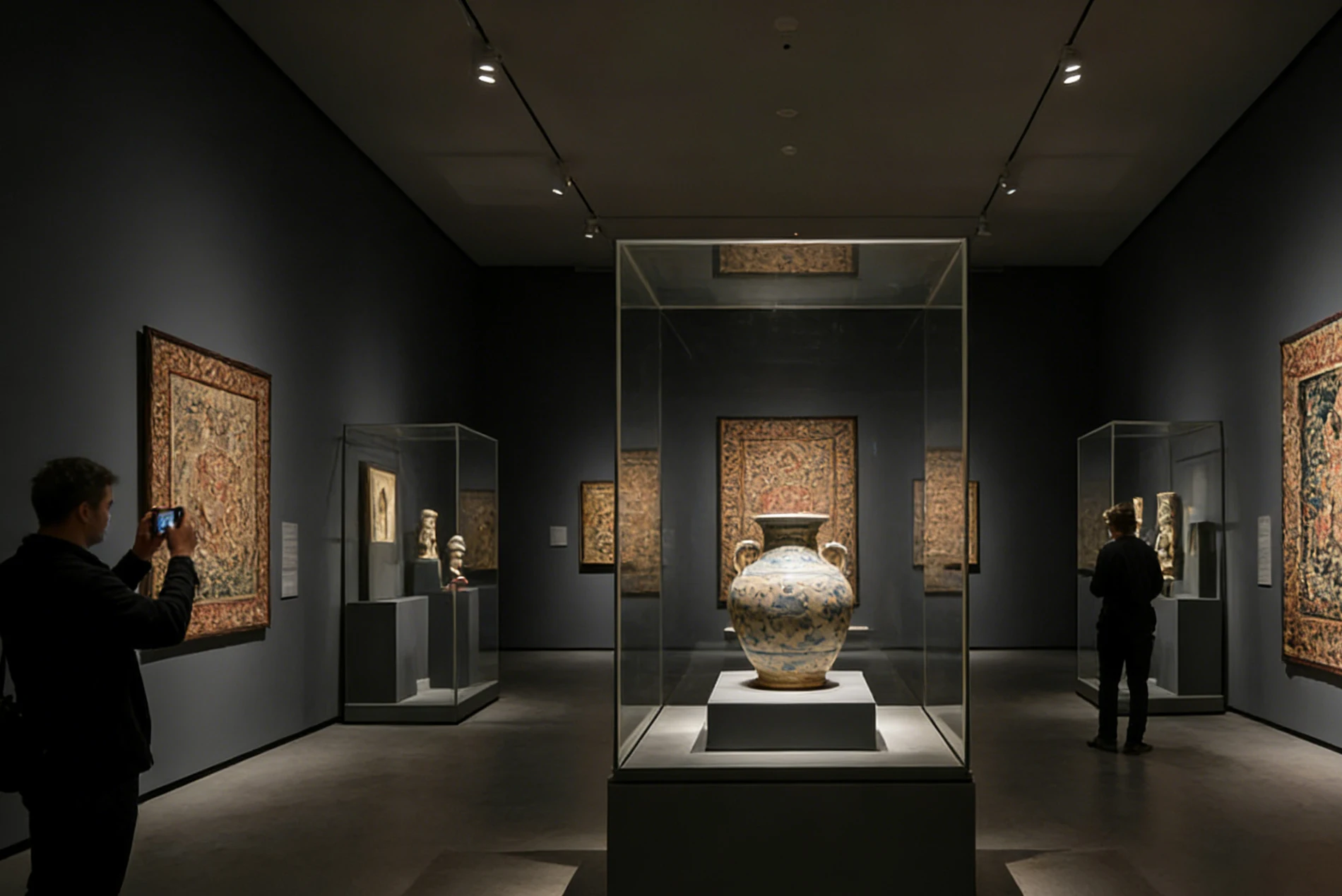
The Museum Lighting Dilemma: Preservation vs. Visibility
Museums face a fundamental tension: artifacts must be visible to visitors, yet light itself is a primary agent of deterioration. Traditional lighting solutions force a compromise between adequate illumination and long-term preservation. Incandescent and halogen lamps emit significant infrared (IR) radiation, causing thermal damage, while many light sources emit ultraviolet (UV) radiation that accelerates photochemical degradation of organic materials like textiles, paper, and pigments.
International standards such as CIE 157:1998 and ISO 3664:2009 provide guidelines for museum lighting, recommending illuminance levels between 50-200 lux depending on the material's sensitivity. However, achieving these levels with traditional sources often introduces harmful radiation and substantial energy costs, as many museum spaces require 24/7 operation for security and visitor experience.
Technical Requirements for Museum Lighting
Effective artifact lighting must meet several critical criteria:
- Illuminance Control: Precise control within 50-200 lux range to match material sensitivity
- Color Rendering: High Color Rendering Index (CRI > 90) to accurately represent artifact colors
- UV/IR Elimination: Zero ultraviolet and infrared radiation to prevent photochemical and thermal damage
- Uniformity: Even light distribution to avoid localized hotspots and shadows
- Energy Efficiency: Reduced operational costs and carbon footprint
These requirements are particularly challenging in underground galleries, basement storage facilities, and interior exhibition halls where natural daylight is unavailable.
Conventional Solutions and Their Limitations
Current museum lighting typically employs:
| Solution | Advantages | Limitations |
|---|---|---|
| Fiber Optic Lighting | Filters UV/IR, precise aiming | High initial cost, limited brightness |
| LED Systems | Energy efficient, long life | Some UV emission, spectral gaps |
| Halogen Lamps | Excellent color rendering | High heat, UV emission, energy intensive |
| Natural Daylight (skylights) | Full spectrum, zero electricity cost | UV/IR present, heat gain, limited to top floors |
While fiber optic lighting is already used in high-end museum applications, traditional systems often rely on artificial light sources (halogen or LED) as the input, limiting their spectral quality and energy efficiency.
Fiber Optic Daylighting: A Paradigm Shift
Fiber optic daylighting systems represent a technological leap by using natural sunlight as the light source, transmitted through high-purity quartz optical fibers. The Dayluxa system exemplifies this approach, combining several key innovations:
Sunlight Collection: A Fresnel lens array mounted on the roof concentrates sunlight, with a GPS chip and astronomical algorithm enabling dual-axis motor tracking to maximize collection efficiency throughout the day.
Optical Fiber Transmission: Low-hydroxyl high-purity quartz fibers transmit visible light while inherently filtering out ultraviolet (UV) and infrared (IR) radiation through the physics of total internal reflection. The fiber's numerical aperture and core diameter are optimized for visible light transmission.
Diffusion Fixtures: Indoor fixtures gently scatter the fiber-delivered sunlight, simulating natural daylight quality with a CRI of 100—identical to direct sunlight. Each fixture includes an integrated LED backup for cloudy days and nighttime operation.
Dayluxa Solution for Museum Applications
For museum artifact lighting, the Dayluxa system can be configured to meet stringent conservation requirements:
| Model | Fibers | Recommended Illuminance (at 1m distance) | Suitable Gallery Area |
|---|---|---|---|
| DY18 | 18 | ≈ 200-300 lux (adjustable via fixture design) | 54m² (special exhibition hall) |
| DP12 | 12 | ≈ 150-200 lux | 36m² (thematic gallery) |
| DP06 | 6 | ≈ 80-120 lux | 18m² (sensitive artifact display) |
Installation Flexibility: Optical fibers can be routed over distances of 30-100 meters, allowing a single rooftop collector to serve multiple galleries across different floors. This eliminates the need for roof openings in basement exhibition spaces.
Precise Illuminance Control: By adjusting the number of fibers per fixture and the fixture's diffusion design, illuminance can be precisely controlled to match the sensitivity of different artifact types—lower for textiles and paper, higher for stone and metal.
Quantifiable Benefits for Heritage Preservation
The Dayluxa system delivers measurable preservation advantages:
- Zero UV Radiation: Eliminates the primary cause of fading and material degradation in organic artifacts
- Zero IR Radiation: Prevents thermal damage and reduces HVAC load in climate-controlled galleries
- Full Spectrum Light: CRI=100 ensures accurate color representation for curatorial work and visitor experience
- Energy Reduction: Daytime operation requires only 12W for the tracking system, compared to kilowatts for equivalent LED or halogen installations
Energy savings are substantial. A typical 100m² gallery illuminated at 150 lux using halogen lamps consumes approximately 3,000W. The Dayluxa DY18 system delivering equivalent illuminance consumes only 12W during daytime operation—a 99.6% reduction in lighting energy consumption.
Case Study: Hypothetical Underground Gallery Project
Consider a 500m² underground museum extension requiring artifact-safe lighting. Traditional solutions would involve extensive electrical infrastructure and ongoing energy costs. A Dayluxa-based solution could include:
- 5x DY36 collectors on the roof (5x36=180 fibers)
- Fibers routed 40-60 meters to underground galleries
- 60 diffusion fixtures (3 fibers each) providing 150-200 lux
- Integrated LED backup for 24/7 operation capability
This configuration would provide museum-quality, artifact-safe illumination with approximately 85% reduction in lighting energy costs compared to a full LED installation, while eliminating all UV/IR radiation risks.
Integration with Museum Conservation Standards
The Dayluxa system aligns with major international conservation standards and green building certifications:
- CIE/ISO Standards: Meets illuminance and spectral requirements for sensitive materials
- LEED Certification: Contributes to "Indoor Environmental Quality" credits through natural daylighting
- WELL Building Standard: Supports circadian rhythm and visual comfort requirements
- National Conservation Guidelines: Compatible with light-sensitive artifact display protocols
The Future of Museum Lighting
As museums increasingly seek sustainable operations and enhanced preservation protocols, fiber optic daylighting offers a compelling convergence of conservation science and energy efficiency. The technology enables a new category of "preservation-positive" lighting that actually improves artifact longevity compared to any artificial alternative, while simultaneously reducing operational costs and carbon footprint.
For curators and museum directors, this represents an opportunity to rethink gallery design—not as windowless boxes dependent on artificial light, but as spaces that can harness natural daylight without its traditional drawbacks, bringing the benefits of sunlight to even the most sensitive collections and deepest underground galleries.