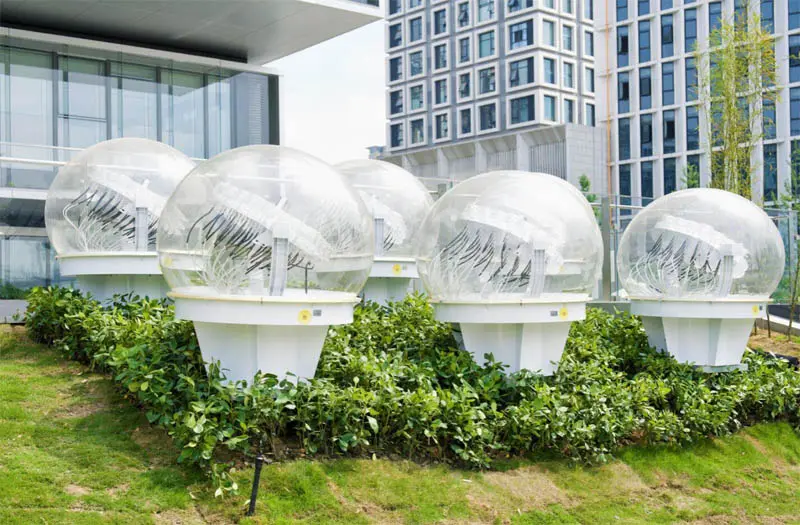
Fiber optic solar daylighting systems are designed to capture natural sunlight and deliver it into interior spaces using optical components rather than electrical light sources. From the perspectives of energy efficiency, visual comfort, and sustainable building design, this technology offers clear advantages. However, from a purely technical standpoint, it is not a universal lighting solution.
The performance and applicability of fiber optic daylighting systems are constrained by fundamental physical laws and practical engineering limitations. Understanding these constraints is essential for setting realistic expectations in real-world projects.
1. Strong Dependence on Solar Irradiance Conditions
The energy input of a fiber optic solar daylighting system is entirely dependent on natural solar radiation. Unlike electric lighting, the available input power is inherently variable and strongly influenced by weather, season, geographic latitude, and time of day.
Even at the same location, the usable luminous flux can vary by several times between clear and overcast conditions. As a result, fiber optic daylighting systems cannot provide a constant light output and are typically used as supplementary lighting rather than a sole illumination source.
2. Physical Limits on Light Transmission Efficiency
From an optical standpoint, all fiber-based transmission systems exhibit unavoidable losses, including coupling losses at the collector, material absorption losses, and additional losses introduced by bending.
Even when high-purity silica fibers are used, these losses cannot be completely eliminated. In practical applications, output illuminance decreases nonlinearly as fiber length increases. Systems such as those developed by Dayluxa must therefore balance transmission distance against usable light output rather than maximizing both simultaneously.
3. Limited Scalability of Light Distribution
Unlike electrical power systems, fiber optic daylighting systems do not support centralized generation with large-scale remote distribution. Each optical fiber functions as an independent light channel, and the amount of luminous flux delivered per fiber is inherently limited.
When higher illuminance levels are required, system capacity is typically increased by adding more fibers. This approach directly increases structural complexity, installation difficulty, and overall system cost. Consequently, fiber optic daylighting is better suited for localized or targeted applications rather than large-area primary lighting.
4. Strong Dependence on Building Conditions
System performance is highly dependent on architectural constraints. Roof area availability, building orientation, shading from surrounding structures, and space for equipment installation all directly affect collection efficiency.
In dense urban environments or retrofit projects involving existing buildings, suitable installation locations for solar collectors may be limited, which further restricts the feasibility of fiber optic daylighting systems.
5. Long-Term Impact of Bending and Installation Quality
While optical fibers are characterized by well-defined parameters under laboratory conditions, real-world installations inevitably introduce additional variables. Routing paths, bending radii, fixation methods, and environmental vibrations can all contribute to increased optical losses.
If minimum bending radius requirements are not strictly respected during installation, initial illuminance levels may appear acceptable but degrade over time. For this reason, systems such as those implemented by Dayluxa often impose stringent installation and construction guidelines to ensure long-term performance.
6. Economic Constraints and Payback Considerations
From a technical perspective, fiber optic solar daylighting systems are material-intensive solutions. High-quality optical fibers, precision solar collectors, and mechanical tracking components contribute to relatively high initial costs.
In most projects, the primary value of such systems lies in energy reduction, improved indoor light quality, and suitability for special-use environments, rather than short-term financial payback alone.
7. Functional Limitations Compared to Artificial Lighting
Natural sunlight cannot be controlled on demand in terms of intensity, color temperature, or operating schedule. This fundamental characteristic limits the functional flexibility of fiber optic daylighting systems.
As a result, practical implementations typically integrate fiber optic daylighting with conventional artificial lighting systems, using intelligent controls to provide supplemental illumination when needed rather than operating independently.
Conclusion: Recognizing Limitations Enables Effective Application
The limitations of fiber optic solar daylighting systems do not represent a failure of the technology, but rather define its appropriate scope of use. When deployed in suitable scenarios and integrated thoughtfully with architectural and lighting systems, the technology can deliver meaningful benefits.
For system providers, including Dayluxa, technical maturity does not imply overcoming all physical boundaries, but continuously narrowing the gap between theoretical performance and reliable engineering implementation.