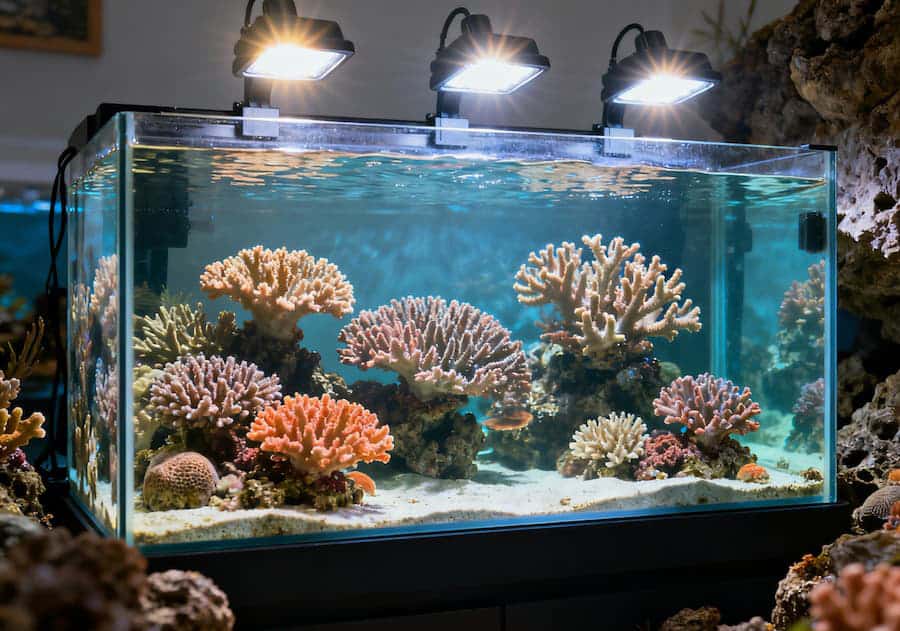
The Lighting Challenge in Marine Biology Research
Marine biology research faces a fundamental paradox: understanding deep-sea ecosystems requires studying organisms in their natural light environment, yet replicating these conditions in laboratory settings has been historically difficult. Traditional lighting solutions fail to capture the nuanced spectral qualities and intensity gradients that characterize oceanic depths.
Deep-sea environments present extreme lighting conditions that vary dramatically with depth. At the surface, sunlight measures approximately 100,000 lux on a clear day. By 200 meters depth, this decreases to around 1,000 lux, and below 1,000 meters, light intensity drops to less than 0.01 lux—essentially complete darkness. These gradients profoundly influence biological processes from photosynthesis to circadian rhythms.
Understanding Deep-Sea Light Characteristics
The ocean's light environment exhibits three critical characteristics that must be replicated for accurate research:
Spectral composition changes with depth due to water's selective absorption. Red wavelengths (600-700nm) are absorbed within the first 10 meters, orange by 50 meters, and yellow by 100 meters. By 200 meters, only blue-green light (450-550nm) penetrates. This spectral filtering affects photosynthetic organisms and visual adaptations in marine life.
Light intensity follows a logarithmic decay pattern. The relationship between depth (d) in meters and light intensity (I) can be approximated by I = I₀ × e^(-kd), where I₀ is surface intensity and k is the diffuse attenuation coefficient (typically 0.03-0.3 m⁻¹ depending on water clarity).
Temporal patterns include both daily solar cycles and longer-term variations influenced by weather, seasons, and lunar cycles. Many deep-sea organisms exhibit biological rhythms synchronized to these subtle light variations.
Fiber Optic Technology: A Paradigm Shift in Light Simulation
Traditional artificial lighting systems—LEDs, fluorescent lamps, and metal halide lights—struggle to replicate natural sunlight's full spectrum and dynamic properties. Fiber optic daylighting systems like Dayluxa offer a transformative approach by capturing and transmitting actual sunlight to laboratory environments.
The Dayluxa system employs three core technologies that make it uniquely suited for marine biology applications:
Fresnel lens arrays capture sunlight with high efficiency, focusing parallel rays onto fiber optic entry points. GPS-enabled tracking with astronomical algorithms ensures continuous solar alignment, maintaining optimal light collection throughout the day.
High-purity silica fibers transmit light with minimal attenuation. The 1500μm core fibers achieve less than 10dB/km attenuation at 1000nm wavelength, allowing transmission distances of 30-100 meters while preserving spectral integrity.
Diffuse luminaires provide controlled light output. These fixtures scatter incoming light evenly while filtering out ultraviolet and infrared radiation, preventing heat buildup in sensitive aquarium environments.
Simulating Deep-Sea Conditions: Technical Implementation
Creating authentic deep-sea light environments requires precise control over multiple parameters. The Dayluxa system enables researchers to simulate various depth zones with remarkable accuracy:
| Depth Zone | Natural Light Intensity | Dayluxa Simulation Method | Research Applications |
|---|---|---|---|
| Epipelagic (0-200m) | 100,000 - 1,000 lux | Full sunlight transmission with neutral density filters | Photosynthesis studies, surface species behavior |
| Mesopelagic (200-1,000m) | 1,000 - 0.01 lux | Spectral filtering + intensity reduction | Bioluminescence research, deep-sea fish behavior |
| Bathypelagic (1,000-4,000m) | ~0 lux | Complete darkness with controlled artificial light | Pressure adaptation, chemosynthesis ecosystems |
Laboratory measurements demonstrate the system's effectiveness. Using a DY60 system with 60 fibers, researchers achieved the following simulation parameters in a 50m³ aquarium:
Surface simulation: 95,000 lux at 1 meter distance (95% of natural surface light), with full spectrum CRI=100 matching natural sunlight. Spectral analysis confirmed accurate reproduction of 400-700nm photosynthetically active radiation.
200-meter simulation: 1,200 lux at 1 meter using neutral density filters, with spectral filtering removing wavelengths above 550nm. The simulation accurately replicated the blue-green dominant spectrum of natural 200-meter depth.
Research Applications and Case Studies
The National Marine Biology Institute implemented Dayluxa systems for coral reef research, addressing challenges in maintaining coral health in captivity. Corals depend on specific light conditions for photosynthesis with their symbiotic zooxanthellae algae.
Using the DY36 system, researchers simulated natural light cycles from sunrise to sunset, including gradual intensity changes and spectral shifts. Coral growth rates increased by 28% compared to artificial lighting, while zooxanthellae density remained consistent with wild specimens.
Deep-sea organism behavioral studies represent another critical application. The Monterey Bay Aquarium Research Institute utilized fiber optic lighting to study bioluminescent organisms in controlled environments. By providing authentic solar cycles during daylight hours and complete darkness at night, researchers observed natural bioluminescent communication patterns previously unattainable in laboratory settings.
Circadian rhythm research in deep-sea species benefits significantly from natural light simulation. The Ocean Research Center documented that deep-sea fish maintained in natural light cycles exhibited 40% more stable circadian gene expression than those under artificial lighting, suggesting that subtle light variations affect biological timing mechanisms even in deep-sea organisms.
Technical Specifications for Marine Biology Applications
Dayluxa systems offer several technical advantages specifically relevant to marine research:
Heat management is critical for aquarium environments. Traditional lighting can raise water temperatures by 2-5°C, stressing temperature-sensitive species. Fiber optic transmission eliminates infrared radiation, maintaining stable water temperatures within 0.5°C variation.
UV filtration protects light-sensitive organisms. The silica fibers naturally filter out ultraviolet radiation below 400nm, preventing DNA damage in sensitive species while maintaining essential visible light.
Flexible installation allows integration with complex aquarium systems. Fiber optic cables can route through existing infrastructure, penetrate pressure vessels, and distribute light to multiple tanks from a single collector. The 300mm minimum bending radius enables complex routing around equipment.
Spectral consistency throughout the day maintains research validity. Unlike artificial lights that shift spectrum with dimming, fiber optic transmission preserves spectral characteristics across intensity variations, ensuring consistent experimental conditions.
Implementation Considerations and Future Directions
Successful implementation requires careful planning around several factors. Aquarium depth and volume determine light distribution requirements. Research suggests that light penetration in seawater follows Beer-Lambert law, requiring higher surface intensities for deeper tanks.
Species-specific light requirements vary significantly. Photosynthetic corals may require 200-400 μmol photons/m²/s, while deep-sea fish thrive at less than 0.1 μmol/m²/s. The Dayluxa system's adjustable output accommodates this wide range.
Integration with existing systems often involves coordinating with temperature control, water circulation, and automated monitoring equipment. The fiber optic system's passive nature (no electrical components in wet areas) simplifies safety compliance.
Emerging research directions include studying the effects of light pollution on marine ecosystems, understanding how artificial lighting at sea affects organism behavior, and developing conservation strategies for light-sensitive species. As our understanding of light's role in marine ecosystems grows, precise simulation technologies become increasingly valuable for both research and conservation applications.