How Fiber Optic Daylighting Systems Work
Field-deployed case study · Fiber-optic daylighting application
How Fiber Optic Daylighting Systems Work
Fiber optic daylighting systems are designed to capture direct sunlight outdoors and deliver it deep into building interiors using optical fibers, without converting solar energy into electricity. Unlike skylights or tubular daylight devices, these systems rely on controlled optical coupling, total internal reflection, and precise solar tracking to maintain usable illuminance over long distances.
This article provides a technical explanation of how fiber optic daylighting systems work, using Dayluxa as a real-world engineering reference rather than a conceptual example.
1. System Overview: From Sunlight to Indoor Illumination
A fiber optic daylighting system consists of four tightly coupled subsystems:
- Solar collection optics
- Solar tracking and alignment mechanism
- Optical fiber transmission medium
- Indoor light distribution and diffusion
The system operates only on direct sunlight (DNI). Diffuse sky radiation contributes minimally and is typically excluded by design to improve coupling efficiency and spectral stability.
2. Solar Collection: Optical Concentration, Not Power Generation
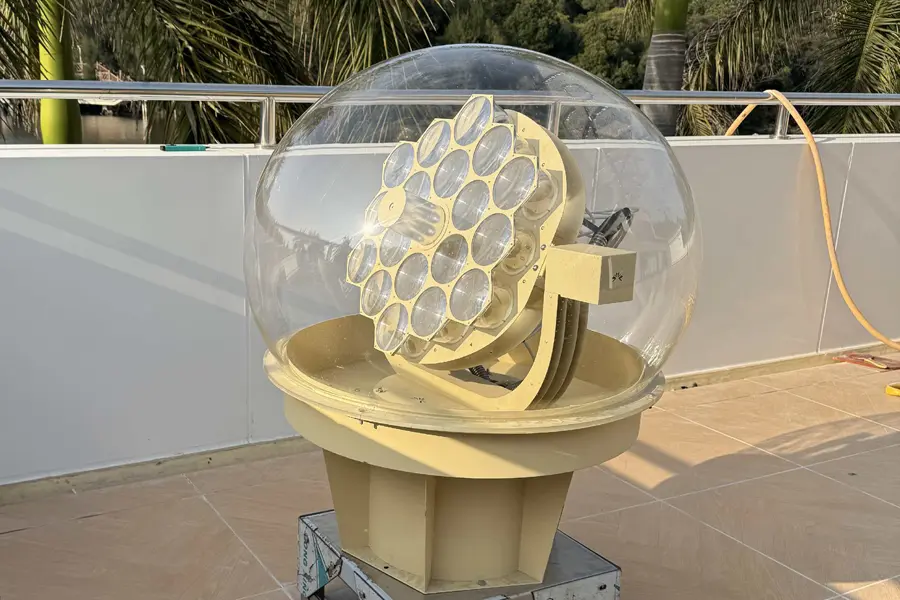
At the collection stage, Fresnel lenses or equivalent concentrators are used to focus parallel solar rays onto a small optical target. Unlike photovoltaic systems, the goal is not energy conversion but angular compression of sunlight to match the acceptance cone of the optical fiber.
In Dayluxa systems, each tracking module aligns the optical axis of the Fresnel lens with the sun using a closed-loop GPS-based solar tracking mechanism. This alignment is critical: even a few degrees of misalignment can reduce coupling efficiency dramatically due to numerical aperture constraints.
3. Optical Coupling and Numerical Aperture Matching
The coupling interface between the concentrator and the fiber determines how much collected light actually enters the transmission system. This is governed by the numerical aperture (NA) of the fiber.
Dayluxa uses large-core plastic-clad silica (PCS) optical fibers with a numerical aperture of approximately 0.37, allowing a relatively wide acceptance angle for incoming rays :contentReference[oaicite:0]{index=0}.
If the incident rays exceed this acceptance cone, they are rejected and lost as heat. This is why precise tracking and optical alignment are more important than raw lens size.
4. Optical Fiber Transmission: Total Internal Reflection in Practice
Once light enters the fiber, it propagates via total internal reflection (TIR) along the core–cladding boundary. For daylighting applications, transmission performance is dominated by three factors:
- Material absorption
- Scattering losses
- Bend-induced attenuation
Dayluxa fibers use low-OH high-purity silica cores to reduce absorption in the visible spectrum, particularly in the 400–700 nm range that dominates human visual response :contentReference[oaicite:1]{index=1}.
Measured attenuation is below 10 dB/km at 1000 nm, which translates to practical daylight transmission over tens or even hundreds of meters when bend radius is properly controlled.
5. Mechanical Constraints: Why Bending Radius Matters
Unlike telecommunications fibers, daylighting fibers operate with very large core diameters (approximately 1500 μm in Dayluxa systems). This increases light-carrying capacity but also makes them more sensitive to mechanical stress.
According to Dayluxa engineering specifications, the minimum short-term bending radius is 150 mm, while long-term installation requires radii of 300 mm or greater to avoid microbending losses and long-term degradation :contentReference[oaicite:2]{index=2}.
Ignoring these constraints can result in exponential light loss that cannot be compensated by larger lenses or stronger tracking motors.
6. Indoor Light Output: Luminous Flux Without Heat or Electricity
At the output end, transmitted sunlight is diffused into the interior space using optical diffusers or hybrid luminaires. Because no electrical conversion occurs, the emitted light preserves:
- Natural solar spectrum
- High color rendering
- No flicker
- Minimal heat gain
This makes fiber optic daylighting particularly suitable for environments where thermal load, electromagnetic interference, or maintenance access are critical concerns.
7. Why Fiber Optic Daylighting Is Engineering-Limited, Not Marketing-Limited
Fiber optic daylighting systems are not universally applicable. They require direct sunlight, precise installation, and strict adherence to optical and mechanical constraints.
However, when deployed correctly, systems such as those developed by Dayluxa demonstrate that transporting real sunlight into deep interior spaces is an optical engineering problem — not a conceptual one.
Conclusion
Fiber optic daylighting works by combining solar tracking, optical concentration, and controlled light transmission into a single engineered system. Its performance is governed by physics, materials, and geometry — not slogans.
Understanding how these systems work at a technical level is essential for evaluating where they make sense, where they do not, and how they differ fundamentally from electric lighting or passive daylighting solutions.