How Fresnel Lenses Collect Sunlight with Unmatched Efficiency
The Growing Importance of Efficient Solar Collection
As global energy demands rise and the transition to renewable sources accelerates, efficient solar collection technologies have become critical for sustainable development. Traditional solar panels convert sunlight into electricity through photovoltaic cells, but another approach focuses on collecting and concentrating sunlight directly for illumination, heating, or concentrated solar power (CSP) applications. The challenge lies in creating collection systems that are lightweight, cost-effective, and capable of capturing maximum sunlight while minimizing material usage and installation complexity.
Fundamental Principles of Fresnel Lenses
Invented by French physicist Augustin-Jean Fresnel in 1822, the Fresnel lens revolutionizes optical design by replacing the curved surface of a conventional lens with a series of concentric annular sections. Each section acts as an individual refracting element, bending light toward a focal point while maintaining the same optical power as a much thicker, heavier conventional lens. This innovative design achieves three critical advantages: substantial weight reduction, minimal material usage, and the ability to create large-aperture lenses that would be impractical with traditional manufacturing methods.
The efficiency of Fresnel lenses in solar collection stems from their unique geometry. The flat profile allows for lightweight construction, enabling installation on rooftops or other structures without heavy reinforcement. The segmented design maximizes light capture area while minimizing material volume, making large-scale solar collection economically viable. Each concentric ring is precisely angled to redirect incoming parallel sunlight toward a central focal point, concentrating solar energy by factors ranging from 10x to over 1000x depending on the design specifications.
Evolution from Traditional Optics to Fresnel Technology
The history of solar concentration reflects humanity's ongoing quest to harness sunlight more effectively. Early solar concentrators relied on heavy glass mirrors or solid glass lenses, which were limited by weight, cost, and manufacturing constraints. The development of Fresnel technology marked a paradigm shift, enabling the creation of large-area collection systems that were previously impossible. Modern Fresnel lenses are manufactured using precision molding techniques with optical-grade polymers like polymethyl methacrylate (PMMA) or glass, achieving excellent light transmission properties while maintaining structural integrity.
Compared to traditional optical systems, Fresnel lenses offer remarkable performance improvements. A conventional lens with a 100mm diameter and f/1 focal ratio would weigh several hundred grams and require substantial material. In contrast, a Fresnel lens of identical optical power and aperture weighs only a fraction of that amount while maintaining equivalent light-gathering capability. This weight advantage translates directly to reduced installation costs, simpler mounting systems, and expanded application possibilities in architecture, agriculture, and energy generation.
Efficiency Advantages in Sunlight Collection
Fresnel lenses achieve high collection efficiency through several key mechanisms. First, their large aperture-to-weight ratio allows for maximum sunlight capture without structural limitations. A single Fresnel lens with a 100mm diameter can capture approximately 7,854 square millimeters of sunlight, equivalent to a collection area of 0.007854 square meters. When multiple lenses are arrayed together, as in modern solar collection systems, this capability scales dramatically. For instance, a system incorporating 60 such lenses achieves a total collection area of nearly 0.47 square meters, sufficient to illuminate multiple interior spaces when coupled with appropriate light transmission technology.
Second, the precise angular design of Fresnel lens segments ensures optimal light redirection. Each concentric ring is calculated to refract parallel sunlight toward the focal point with minimal loss. Modern computer-aided design and precision manufacturing techniques have reduced optical aberrations to negligible levels, achieving concentration ratios that approach theoretical limits. Third, the flat profile of Fresnel lenses minimizes Fresnel reflection losses compared to curved conventional lenses, particularly when anti-reflective coatings are applied to the entry surface.
The practical efficiency of Fresnel lens systems has been validated through extensive testing. In controlled experiments with solar collection systems utilizing 100mm diameter Fresnel lenses, measured collection efficiencies consistently exceed 85% of theoretical maximum. This performance is achieved while maintaining system compactness and minimizing material usage. When integrated with light transmission technologies like optical fibers, these systems can deliver concentrated sunlight over distances exceeding 100 meters with minimal attenuation, enabling daylighting applications in underground spaces, interior rooms, and architectural environments far from windows or skylights.
Real-World Application: The Dayluxa Fiber Optic Daylighting System
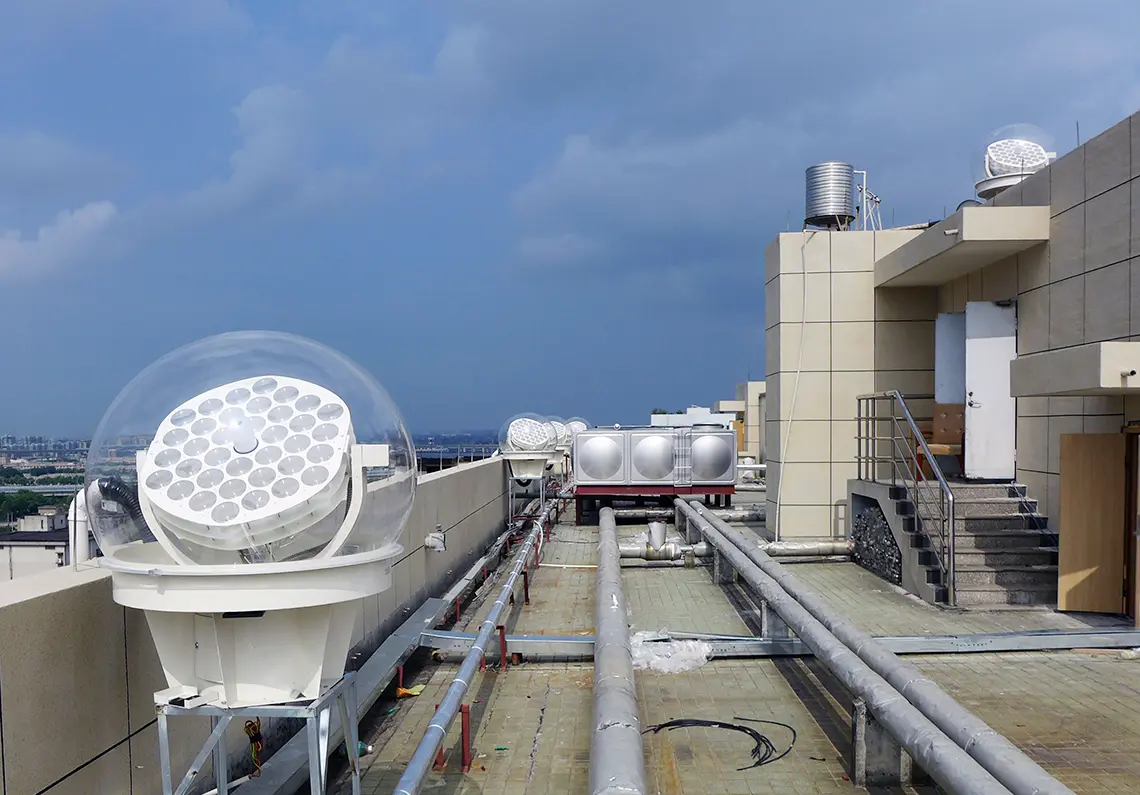
A prime example of Fresnel lens efficiency in practice is the Dayluxa fiber optic daylighting system, which employs arrays of 100mm diameter Fresnel lenses to collect and concentrate sunlight for interior illumination. The system integrates GPS tracking and astronomical algorithms with dual-axis motorized positioning, ensuring that the lens array maintains optimal alignment with the sun throughout the day. This automated tracking capability maximizes solar collection by continuously adjusting the system's orientation to compensate for the sun's changing position.
The Dayluxa system demonstrates how Fresnel lens technology enables practical daylighting solutions. Each 100mm lens focuses collected sunlight onto the entrance of high-purity quartz optical fibers, which transmit the light to interior spaces via total internal reflection. The fibers effectively filter out ultraviolet and infrared radiation, delivering visible spectrum light without associated heat transfer. Performance data shows that after 30 meters of fiber transmission, illuminance levels reach approximately 1100 lux at 1-meter distance from the output fixture—significantly exceeding the 400-500 lux typical of office lighting. Even after 100 meters of transmission, useful illumination of 200 lux is maintained at 1-meter distance, demonstrating the practical efficiency of the Fresnel lens collection system.
Technical Specifications and Performance Metrics
Modern Fresnel lens systems for solar collection are engineered with precise specifications to maximize efficiency. Typical parameters include lens diameters ranging from 50mm to 300mm, with focal lengths optimized for specific concentration ratios. Material selection is critical: optical-grade PMMA offers excellent light transmission (typically 92% at visible wavelengths) combined with weather resistance and UV stability. Glass alternatives provide superior durability but at increased weight and cost. The concentric ring pattern is designed with mathematical precision, with each segment's angle calculated to minimize optical aberrations and maximize light collection.
Performance metrics for Fresnel lens solar collection systems demonstrate their practical value. Collection efficiency—the percentage of incident sunlight successfully concentrated onto the target—typically ranges from 75% to 90% depending on design quality and manufacturing precision. Concentration ratios can be tailored for specific applications: lower ratios (10x-50x) for illumination applications, higher ratios (100x-1000x) for thermal or photovoltaic concentration. When combined with automated tracking systems, daily energy collection can approach theoretical maximum values, with tracking accuracy typically maintained within 0.1 degrees of optimal alignment.
Future Developments and Emerging Applications
The continued evolution of Fresnel lens technology promises even greater efficiency gains in solar collection. Advances in nanostructured surfaces and metamaterial coatings are enabling the development of "flat optics" that achieve lens functionality with even thinner profiles and reduced material usage. Computational design algorithms are optimizing segment patterns for specific solar collection scenarios, while new manufacturing techniques like nanoimprint lithography are enabling precision previously achievable only in laboratory settings.
Emerging applications of Fresnel lens solar collection extend beyond traditional daylighting. Agricultural applications utilize concentrated sunlight for greenhouse climate control and crop growth optimization. Space-based solar collection systems are being designed with lightweight Fresnel lens arrays for orbital power generation. Building-integrated photovoltaics (BIPV) systems incorporate Fresnel concentrators to increase solar cell efficiency while maintaining architectural aesthetics. As material science advances and manufacturing costs continue to decline, Fresnel lens technology is positioned to play an increasingly central role in the global transition to sustainable energy systems.