Dayluxa How Fresnel Lenses Collect Sunlight
Understanding Solar Concentration
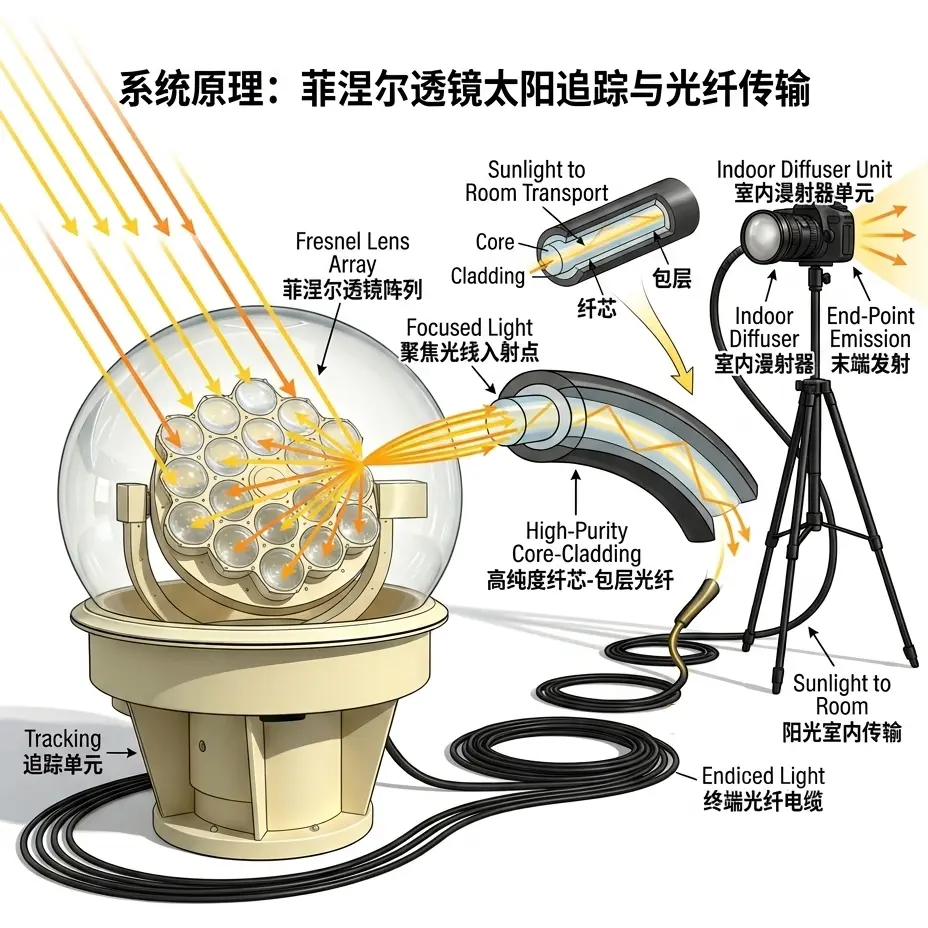
When sunlight travels through the atmosphere and reaches Earth's surface, it arrives as parallel rays due to the enormous distance between the sun and our planet. This parallel nature of solar radiation is fundamental to how modern daylighting systems capture and direct natural light into building interiors. The key to efficient solar collection lies in optical concentration, and Fresnel lenses have emerged as the preferred solution for fiber optic daylighting systems due to their unique combination of high optical efficiency and compact design.
The basic principle involves redirecting parallel solar rays through a specially configured lens surface that converges them toward a single focal point. This concentrated light can then be efficiently captured by the entrance face of an optical fiber, enabling transmission over distances that would be impossible with uncaptured sunlight. The effectiveness of this approach depends critically on the lens design, the precision of solar tracking, and the quality of the fiber optic delivery system.
The Physics of Fresnel Lenses
Fresnel lenses were invented by French physicist Augustin-Jean Fresnel in the early 19th century for use in lighthouses. The innovation lies in replacing a solid convex lens with a series of concentric annular rings, each with the same curvature as the corresponding section of the original lens. This design dramatically reduces weight and material costs while maintaining most of the optical performance.
Each concentric ring on a Fresnel lens surface is calculated to refract incoming parallel rays toward the focal point. When sunlight strikes the lens, the rays are bent according to Snell's law, which describes how light changes direction when moving between media of different optical densities. The angle of refraction depends on the refractive indices of the two materials and the angle at which the light enters the lens surface.
The mathematical relationship can be expressed as n1·sin(θ1) = n2·sin(θ2), where n1 and n2 are the refractive indices of air and the lens material respectively, and θ1 and θ2 are the angles of incidence and refraction. For a typical Fresnel lens made from optical-grade polymer or glass with a refractive index of approximately 1.5, the light bending characteristics are precisely engineered to achieve optimal concentration at the target focal distance.
Why Fresnel Lenses Excel at Solar Collection
Fresnel lenses offer several distinct advantages that make them particularly suitable for solar collection applications. First, their ability to achieve high concentration ratios while maintaining a thin profile is unmatched by traditional lens designs. A single Fresnel lens can concentrate sunlight by a factor of 500 to 1000 times, creating an intense focal spot that can be efficiently coupled into an optical fiber.
Second, the optical efficiency of Fresnel lenses typically exceeds 85% under ideal conditions, meaning the vast majority of incoming sunlight is successfully redirected toward the focal point rather than being lost to absorption or scatter. This high efficiency translates directly to better indoor illumination levels and more effective use of the collected solar energy.
Third, the modular nature of Fresnel lens arrays allows system designers to scale collection area without proportional increases in system complexity. A Dayluxa DY60 system, for example, utilizes 60 individual Fresnel lens units to achieve a total collection area that would be impractical with a single large lens. This modular approach also provides redundancy—if one lens is partially obstructed, the remaining lenses continue functioning.
Integration with Fiber Optic Transmission
The connection between Fresnel lens collectors and fiber optic transmission systems represents a critical interface in daylighting design. The concentrated light at the focal point must be precisely aligned with the entrance aperture of the optical fiber to achieve efficient coupling. The numerical aperture (NA) of the fiber, typically 0.37 for high-quality quartz fibers, determines the acceptance angle within which light can be successfully transmitted.
When the concentrated solar beam enters the fiber core, it undergoes total internal reflection at the core-cladding boundary. This phenomenon occurs because the refractive index of the core (approximately 1.47 for quartz) is higher than that of the cladding (approximately 1.46), creating conditions where light rays above a certain critical angle are completely reflected rather than escaping through the cladding. This mechanism allows light to travel through kilometers of optical fiber with minimal loss.
The quality of this interface directly affects system performance. Proper alignment ensures that the concentrated light enters within the fiber's acceptance cone, maximizing the energy transferred to the indoor delivery system. Misalignment, even by small amounts, can result in significant light loss and reduced illumination at the output end.
Real-World Performance Data
Laboratory testing and field installations have established clear performance benchmarks for Fresnel-based daylighting systems. Under clear sky conditions with approximately 150,000 lux of ambient sunlight, a single Fresnel lens collector paired with a 30-meter quartz fiber can deliver approximately 1,100 lux at one-meter illumination distance—significantly higher than the 300-500 lux typically required for office environments.
At greater transmission distances, performance naturally decreases but remains substantial. With 50 meters of fiber, illumination at one meter reaches approximately 800 lux, still meeting general office lighting requirements. Even at 100 meters—the practical upper limit for most residential and commercial applications—approximately 200 lux is achievable, adequate for basement areas, storage facilities, and other spaces where supplementary natural light would otherwise be unavailable.
These figures demonstrate that Fresnel lens collection combined with fiber optic transmission can meaningfully extend natural daylighting into building zones that traditional approaches cannot reach. The technology enables architects and building owners to provide genuine sunlight to underground levels, interior rooms, and other spaces historically dependent on artificial lighting.
Applications and Design Considerations
The integration of Fresnel lens collectors with intelligent solar tracking systems represents the current state of the art in natural daylighting. Modern systems like Dayluxa incorporate GPS chips and astronomical algorithms to continuously adjust collector orientation, maintaining optimal sun-facing alignment throughout the day and across seasons. This dynamic tracking ensures that the focal point remains precisely positioned at the fiber entrance, maximizing energy collection.
System sizing requires careful analysis of target illumination levels, transmission distances, and the number of delivery points. A DY60 system with 60 optical fibers can support 20 diffusion fixtures at three fibers per fixture or ten fixtures at six fibers per fixture, providing flexibility in distribution design. This adaptability makes fiber optic daylighting suitable for diverse applications from underground parking garages to hospital wards, from school classrooms to residential basements.
The health benefits of natural light delivered through this technology extend beyond simple illumination. Research from Cornell University indicates that exposure to natural light can improve work efficiency by 15-20%. Studies from the China CDC show that students in naturally lit classrooms experience 25-30% lower myopia rates. Harvard Medical School research links natural light exposure to reduced seasonal affective disorder symptoms. These findings underscore the value of bringing genuine sunlight—not merely artificial approximation—into building interiors.