Replicating the Ocean's Sun — Sustainable Coral Cultivation with Dayluxa Quartz Fiber Technology
Field-deployed case study · Fiber-optic daylighting application
Project Overview
This case study documents a real-world deployment in a controlled coral cultivation facility, focusing on how natural sunlight was introduced into enclosed aquatic environments through a structured and repeatable system configuration.
On-Site Cultivation Setup
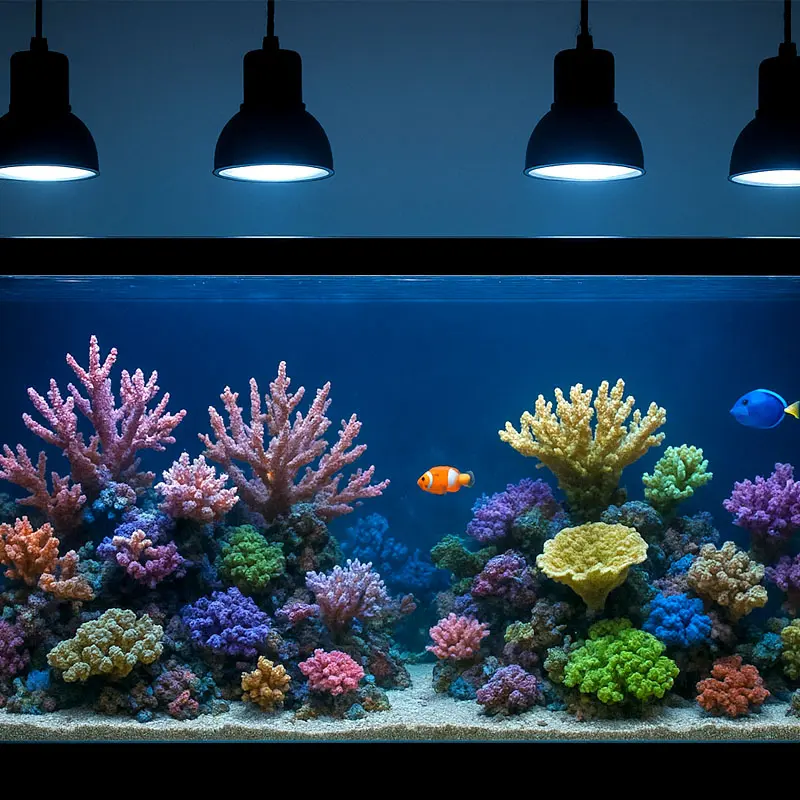
The facility operates multiple shallow coral cultivation tanks designed for research and sustainable propagation. Individual tanks measure approximately 1.5–2.0 meters in length, with water depth optimized for shallow-reef species.
The primary challenge was to deliver sufficient daytime illumination without introducing thermal stress or spectral distortion commonly associated with artificial lighting systems.
Lighting System Configuration
The deployed solution utilizes six Dayluxa DY18 solar lighting units. Each DY18 unit integrates 18 Fresnel lenses for outdoor sunlight collection and concentration.
- Total daylighting units installed: 6
- Fresnel lenses per unit: 18
- Optical fibers connected per unit: 3
- Total optical fibers delivering sunlight: 18
This modular configuration allows sunlight to be distributed evenly across multiple tanks, avoiding localized over-illumination while maintaining consistent overall light availability.
Optical Transmission Design
Collected sunlight is transmitted indoors via low-OH, high-purity quartz optical fibers. The fibers feature a large core diameter and wide numerical aperture, enabling efficient acceptance of concentrated sunlight and stable transmission across the required routing distances.
Each fiber delivers light without conducting heat, allowing lighting performance to remain decoupled from thermal management strategies.
Deployment Rationale
Rather than relying on a single high-capacity collector, multiple DY18 units were deployed to improve spatial uniformity and system redundancy.
The use of three optical fibers per unit provided flexibility in positioning light outputs above individual tanks or specific cultivation zones, supporting scalable expansion as additional tanks are added.
Operational Observations
During operation, the system delivered dynamic daylight intensity that followed natural diurnal patterns. Coral specimens exhibited consistent polyp extension during daylight hours, with stable coloration observed throughout the growth cycle.
Facility operators reported reduced reliance on artificial lighting during daytime operation, simplifying temperature control and lowering overall energy consumption.
Key Learnings
This deployment demonstrates that engineering-focused daylight delivery systems can be configured as repeatable and scalable solutions for controlled cultivation environments. Clear definition of system quantities and optical distribution is critical to achieving uniform and biologically aligned lighting outcomes.