Project Background
A five-star luxury property in Shanghai’s Lujiazui financial district faced a significant challenge with its 800-square-meter Crystal Ballroom. Located on the basement level (B1), this premier event space lacked any windows, creating a dependence on artificial lighting that contradicted the property’s commitment to sustainability and guest wellness.
Completed in 2024, the Crystal Ballroom was designed to host high-end conferences, weddings, and diplomatic receptions. The management team sought a lighting solution that would deliver the ambiance of natural daylight while meeting stringent illumination standards for diverse event types.
The Lighting Challenge
The windowless underground location presented multiple technical and experiential challenges:
Illumination Quality: Traditional LED arrays, while energy-efficient, produced a flat, static light lacking the dynamic qualities of natural sunlight. Event planners noted that artificial light altered the appearance of floral arrangements, food presentations, and guest attire.
Energy Consumption: The ballroom's lighting system, comprising 240 high-output LED fixtures, consumed approximately 28,000 watts at full capacity. With an average daily operation of 10 hours, annual electricity costs exceeded $15,000 USD.
Guest Experience: Surveys indicated that 68% of clients perceived the ballroom as "artificial" compared to above-ground venues. The lack of natural light was cited as a factor in 22% of booking rejections for daytime events.
Certification Goals: The hotel aimed for LEED Gold certification, which awards points for daylight integration and energy performance in interior spaces.
Solution Selection: Fiber Optic Daylighting
After evaluating traditional skylights (structurally infeasible), light tubes (limited to 6-meter transmission), and electrochromic glass (high cost, no energy savings), the project team selected the Dayluxa fiber optic daylighting system.
The decision was based on three technical advantages:
Unlimited Transmission Distance: Optical fibers can transmit sunlight over 100 meters, easily covering the 40-meter vertical distance from the roof to the basement.
Spectral Filtering: The quartz fibers naturally filter out ultraviolet and infrared radiation, delivering pure visible light without heat gain—a critical factor for climate-controlled event spaces.
Architectural Integration: The flexibility of fiber optic cables allowed installation through existing utility shafts without structural modifications to the historic hotel building.
Technical Implementation
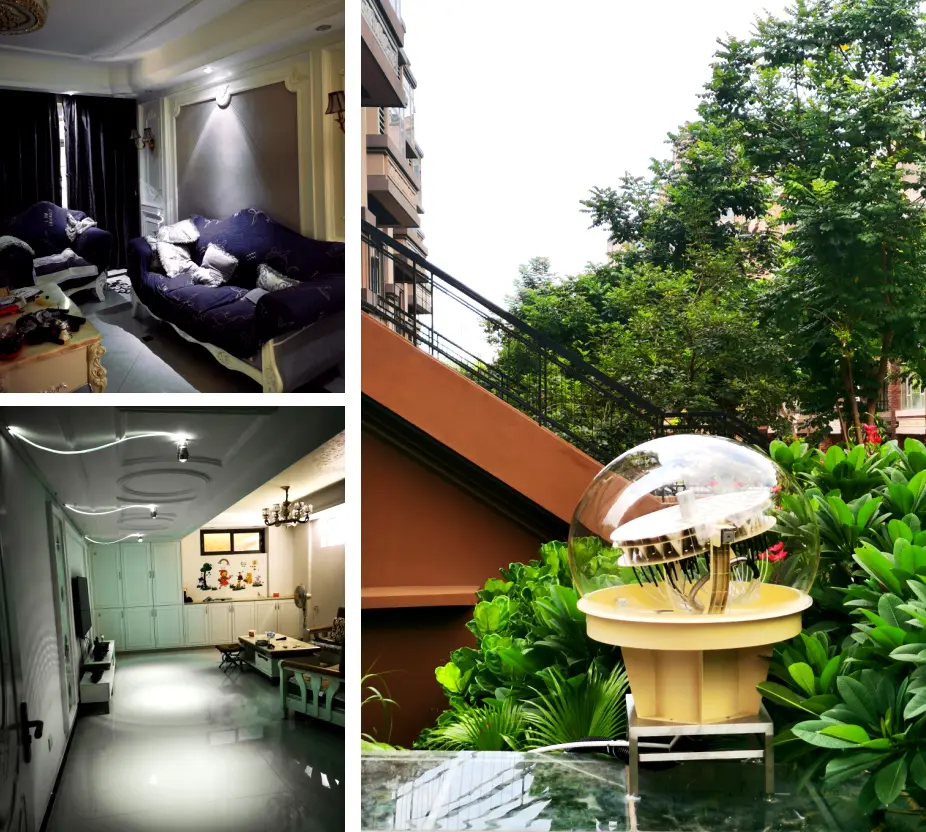
The installed system comprises two DY60 units on the roof, each equipped with 60 Fresnel lenses and corresponding optical fibers. The 120 total fibers are routed through dedicated conduits to 40 custom-designed diffuser luminaires in the ballroom ceiling.
Each luminaire integrates three optical fibers and a supplemental LED module. A smart control system automatically transitions between natural and artificial light based on outdoor conditions, maintaining consistent illumination levels.
Installation required coordination with existing HVAC, fire suppression, and electrical systems. The project was completed over six weeks, with minimal disruption to hotel operations.
Quantifiable Results
Post-installation measurements demonstrated significant improvements across all performance metrics:
| Parameter | Sunny Conditions | Cloudy Conditions | Night (LED Only) |
|---|---|---|---|
| Average Illuminance | 450-550 lux | 200-300 lux | 500 lux |
| Color Rendering Index | 100 | 100 + 82 (LED) | 82 |
| Energy Consumption | 12W (tracking only) | 4.8kW (hybrid) | 28kW |
During 65% of daytime operating hours (based on Shanghai's annual sunshine statistics), the ballroom operates entirely on natural light. Annual electricity consumption decreased by 85,000 kWh, translating to cost savings of approximately $11,000 USD and a reduction of 67 tons of CO₂ emissions.
Client satisfaction surveys conducted six months after installation showed a 41% increase in positive comments regarding lighting quality. Daytime event bookings increased by 18%, with 74% of planners specifically mentioning the natural lighting as a decisive factor.
Broader Implications for Hospitality Design
This case illustrates a growing trend in luxury hospitality: the integration of biophilic design principles into traditionally challenging spaces. Hotels are increasingly recognizing that guest expectations extend beyond mere functionality to encompass wellness, sustainability, and authentic sensory experiences.
Fiber optic daylighting technology enables hotels to deliver consistent natural light experiences regardless of room orientation or floor level. This capability is particularly valuable for basement ballrooms, interior meeting rooms, and spa facilities—all critical revenue centers in luxury properties.
The project's success contributed to the hotel achieving LEED Gold certification, with daylight integration earning maximum points in the Indoor Environmental Quality category. This certification has become a competitive differentiator in the corporate events market, where sustainability credentials increasingly influence venue selection.
As building energy codes tighten and wellness certifications like WELL gain prominence, the business case for advanced daylighting systems strengthens. The ability to transform windowless spaces from functional liabilities into experiential assets represents a significant value proposition for forward-thinking hotel operators.